

What Is a Circadian Rhythm Actually?
The circadian rhythm operates as kind of inner time system for your body for about 24 hours, which is guiding if you are feeling awake, sleepy, when you want a food, activity periods or your mood might shift too in day. You could call it your own biological clock that is quietly in charge of different hidden functions. The way sleep occurs, hormones get released, digestion going on, temperature of body, energy as well these all are influenced by this cycle. This time system is handled by a small but strong brain part that organizes massive biological jobs. While rhythm works by itself, it sometimes gets altered by signals from outside environment.
How does circadian rhythm work?
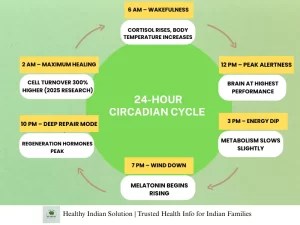
Circadian rhythm is actually an inside timing mechanism of your body that helps every part work at good speed for whole day. Circadian comes from the Latin language, it means “around an day,” which is kind of a pretty exact way for talking about 24 hour pattern that controls energy or even things like how food digests.
But your body does not just do things at random. Instead, there is a pattern to it. Different things in body are made to be most active at certain moments. The brain works better in early day, body fixes itself at nighttime, and your metabolism tries to match when you usually have your meals. I find this really interesting.
How Your Body Puts Together All These Actions
This type of daily rhythmic pattern makes your body get mind and physical actions timed together. To give an example:
Your endocrine functions change up with an hormones like cortisol and it helps your alertness level and giving you energy.
Your digestive organs get enzymes and certain proteins ready when you are about to eat common meals. Things like temperature, emotional mood and immune functions keep changing through the day because of this inside clock.
Each system and organ runs on a schedule still all are coordinating through one main master timekeeper. I think this is kind of amazing.
The Master Clock Found In Your Brain
Your body’s largest clock is found in part of the brain named a suprachiasmatic nucleus (SCN) which is quite small but plays an big role for circadian rhythm. The SCN is inside the hypothalamus which is the body’s region that keeps everything balanced.
Some “clock genes” inside these groups of brain cells start working and stopping in certain rhythm. These cycles send out signals through the body so different organs know that they should become faster, slow themselves start repairs or take a rest. This is the reason that heartbeat as well as hunger patterns are also on daily cycles.
Why Light Is the Most Important Factor
The SCN has big flaw. It is very responsive to presence of light. Whenever a light comes into your eyes, even when you are not yet completely awake, messages are sent to the SCN which resets your inner clock. This is why humans get used to daylight and also darkness automatically.
When it is morning, your brain gets the light and will be more awake, with less melatonin and gets you ready for doing stuff.
Darkness at night gives signal to boost the melatonin and the body starts relaxing.
Since light is acting like main button to reset, the body’s circadian rhythms stick closely to when sun goes up and down. If you break this rhythm for example, with late screen usage or not maintaining a good sleep time it can upset the system.
Why Your Routine Fails When It Doesn’t Match Your Body Clock?
Your body actually operates by an built-in 24-hour cycle that is called the circadian rhythm. When the activities of your each day are not matching well with this inner clock it makes your body work in opposition to itself. This kind of mismatch can affect thinking, mood digestion processes sleep, and also the skin of yours reacts differently.
1. Your hormones run on a schedule not on your to-do list
Hormones including cortisol, melatonin, insulin and plus growth hormone become higher or lower at some certain times.
If routines do not match with those normal high points:
When you work late, brain is in wind-down mode, and so productivity goes down.
If you eat later, an insulin gets thrown off, which slows down digestion and makes weight management harder.
When people stay awake at times melatonin is increased, their healing, immunity and skin’s normal restoration becomes weaker.
Research from 2025 shows that mismatch meals and the sleep makes like “circadian mismatching”. This raises tiredness and makes thinking performance drop.
2. Your metabolism expects food at certain hours
Your digestive system creates gut hormones and enzymes by normal meal times. If you take a meals during random times or eat too late:
The body has tendency to put more calories into storage and burns less.
Having food at night leads digestion not working so well.
Gut microbiome timing becomes kind of mixed up, connecting to gas food wanting and metabolism getting slower as seen from studies of 2024 and 2025.
3. Your brain’s master clock resets with light
The SCN, also known as main brain clock, is mainly influenced by the light. When daily routines conflict with normal daylight patterns:
You might feel more slow in morning
Sleep gets less deep and does not refresh well.
Ability to stay focused gets worse during whole day.
Researchers in 2025 say that a bright light in the morning can make people more alert and repair bad clocks quicker than naps or drinking a coffee.
4. Your skin has its own 24-hr schedule
Skin goes into two options:
Daytime: mainly it guards from UV, bad air and things like a germs
At night: does restoration things like renewing cells, fixing DNA, creating an more collagen if your schedule is not matching up:
Nighttime fixing ability gets more lower. Active things like acids or retinoids will not work as good. You might have more pimples, lose the glow and look old faster.
New skin studies from 2024/2025 say bad sleep can harm the skin’s shield, healing slows down almost 30 percent. Sometimes, like, the restoration power of skin feels weaker. I explained him that it is kind of connected with circadian rhythm. So, keep track of the timing of your skin’s needs and help it properly.
5. Your activity and energy rhythm do not match
Human bodies have certain periods of higher alertness in mornings or midday while afternoons and evenings bring tiredness. If you plan things opposite to a these high times:
1. Exercise will seem much tougher.
2. Studying does not go well.
3. Creativity or energetic jobs have less focus Studies in 2025 said output increases by 20 to 40 percent if you do work during the optimal circadian hours.
What is Circadian Skincare in Simple Words
“Do you use the correct products but at times when it is not the best for you?” is actually important part in circadian skincare.
Circadian skincare means not cream or some kind of a temporary fashion, but it is a way to look after your skin by considering the way it acts along a 24-hour natural time cycle. In the day and the night your skin will not act equal. Its needs, the strong points, weak abilities and fixings all change in natural timings.
According to dermatologists in 2025, the skin’s working follows normal time routines, and putting your skincare to fit these daily changes sometimes can improve the product and also has less skin trouble.
Skin Has a Day Mode and a Night Mode
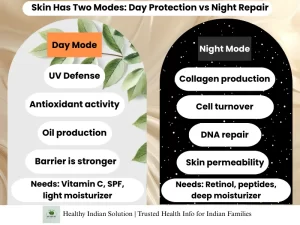
Your skin goes into two vital biological conditions:
1. Day = Defense Mode
During daytime hours, skin is protecting you against factors coming from outside. The routines it follows are such as:
1. Making the skin barrier more stronger.
2. Giving protection against a UV, pollution and blue rays.
3. Focusing on more antioxidant production.
4. Managing level of oil and microbial stability.
5. Lowering reaction to outside stressors.
2024–25 studies mention that antioxidant defense in skin is highest early in day. This is the reason that using the SPF and antioxidant products in mornings has more positive effects compared to the nighttime usage.
If you want to boost your natural daytime glow even more, check out our guide: 10 Best Home Remedies for Glowing Skin Naturally (Dermatologist-Approved)
2. Night = Mode of Repair and Renewal
When darkness comes, your skin tries to recover.
Night actions are kind of like:
1. Generating more of collagen.
2. Repairing DNA parts.
3. Turnover of the cells and getting rid of dead cells.
4. Rebuilding barrier part.
5. Moisturizing much deeper.
6. Better soak-up of active chemicals.
Circadian biology in 2025 showed cell regrowth is 2 to 3 times much higher at night. This means the night is an ideal period for using retinoids, peptides, niacinamide, an acids or barrier-fixing creams.
Why Choosing Right Moment Is More Important Than Just Skincare Products
Even if you select very pricey or an high-quality skincare, applying it at not ideal time can lead to much fewer results than expected.
In simpler terms, modern chronobiology points out few things:
1. At night skin takes in ingredients that help restoration much more. Melatonin levels and repair enzymes increase at night,so skin deals with stronger actives well.Because barrier is thinner during nighttime, deeper formulas get absorbed best.
2. The skin oil comes to maximum level in day hours, therefore putting thick creams in morning often gives congestion.
3. Your body protection is not strongest in the nighttime period, so putting the SPF at night provides zero outcome.
4. So the main idea is: align products with your body’s skin timing to get better benefits and less discomfort.
Circadian skincare follows this principle.
Simple Logic of Circadian Skincare
1. Morning = Protect
Give skin what it needs to survive the day (SPF, antioxidants, light hydration).
2. Night = Repair
Give skin what it needs to regrow, heal, smooth, and strengthen (retinoids, acids, peptides, ceramides).
Your products don’t need to change your timing does.
How Your Skin Behaves in 24 Hours (Time-Based)
6 AM – 9 AM: Skin Wake-Up Period
What Goes On Biologically
- Skin layer is at weakest point when the night’s natural repair cycle has finished.
- Moisture is lower, since water from skin is lost at higher rate until first few hours of morning.
- Cortisol is gradually going up, that leads to skin becoming a bit more sensitively.
- Production of natural oils is also starting to rise as body prepares itself to be protected during daylight.
- There is more sensitivity to the skin care items at this part of day and dermatology information from 2025 has shown the morning weakness in barrier.
What Should Be Done
1. Select mild facial wash, so the weak skin in morning is not stripped.
2. Put hydrating substances like an hyaluronic acid or glycerin.
3. Also use antioxidant products. Vitamin C, niacinamide or green tea.
4. Use sun cream in range SPF 30-50. It is required.
What Should Not Be Done
1. No strong acids (such as retinoids, AHAs, BHAs).
2. Keep away from thick oils or butters because skin may get blocked.
3. Do not skip sunblock even if sun is faint at first.Skin gets more sensitive after 8 AM.
Common Mistakes
1. Washing face too harshly early in morning.
2. Applying nighttime creams while it still is daytime.
3. Leaving sunscreen out thinking that “the sun isn’t strong right now.”
12 PM to 3 PM: Most Intense Environmental Stress Peak
What’s Happening Biologically
- The amount of UV radiation reaches highest point. This leads to bigger danger for DNA to be damaged.
- Heat goes up sweat increases and pollutants raise oxidative stress on the skin. Oil glands work more actively, so skin gets more dust and germs stuck.
- The antioxidant level inside of skin starts dropping because it gets used up in the morning.
- Data from 2025 shows that inflammation markers in skin climb around this time, most often if people do not use an SPF product.
Why SPF is very necessary
1. It helps blocking DNA breakdown from sunlight.
2. Keeps collagen away from being ruined during day.
3. Reduces creating too much melanin so spots are better controlled.
4. An SPF of broad spectrum and putting it again keeps the skin’s barrier better for longer time.
What actions should be taken
1. Put SPF again every 2 to 3 hours when staying outside.
2. Use bloating sheets instead of harsh washing.
3. Drink more water because being hydrated helps skin balance its temperature.
7 PM – 10 PM: Repair Mode
What’s Happening Biologically
- During this time, skin changes from guarding to fixing.
- Blood moves more to skin surface.
- The making of collagen and elastin proteins starts to go up.
- Skin will get easier for things to get in so treatments sink in deeper.
- pH goes higher, this which supports that cell renewal and more exfoliation.
- New study from the 2025 says right after sunset, repair enzymes at night activate quick.
What You Should Do
1. Retinoids, peptides, niacinamide or using an exfoliant acids can be chosen in your schedule.
2. Put on the heavier moisturizer to keep night barrier strong.
3. If you have been outdoors, do double cleansing.
What You Should Avoid
1. Too much layering of 5 to 7 products is not good. Too many layers means more irritation because skin lets in more at night.
2. Do not sleep without washing as pollution sticks to DNA harming particles.
1 AM to 3 AM: Peak Time for Regeneration
“Is your skin healing or having an trouble when you are sleeping?”
What’s Happening Biologically
This period is considered mainly when lots of recovery occurs.
- Cells change at dynamic rate.
- Making of the collagen reaches its high mark.
- Melatonin, which is the main antioxidant in the skin, is most intense in its effect.
- Rebuilding of skin shield happens very effective.
- Tiny damages from sunlight and pollution are fixed by fastest mechanism.
Reports in 2025 related to circadian dermatology say that bad sleep at this time will lower next morning’s brightness of skin and bump up inflammation signals by anywhere from 25 to 40 percent.
Importance of This Hour for Next Day Appearance
When proper actives are put earlier in the evening, the skin takes this period and fixes itself deeply.But dehydration, irritation, or if your skin is dirty, it will have problems fixing up.
Steps to Take Before1. Use repairing type ingredients such as retinoids, peptides or ceramides.
2. It is good to sleep ahead of an 12:30 AM so best regeneration can be done.
3. Put humidifier or hydrating product if you sleep in air conditioning.
Morning Routine (Day Skincare) Made to Work with Your Body’s Natural Sleep Cycle
Your morning routine should protect, hydrate, and shield your skin from UV rays and pollution. This is because your skin’s barrier is naturally weak, dehydrated, and vulnerable when you wake up (2025 dermatology research backs this up).
Why Morning Skincare Is Different (Circadian Science 2025)
- Barrier function is at its lowest in the morning, so skin loses moisture easily.
- Sebum is low, which makes the skin dry and dull.
- UV sensitivity is highest around noon, so it needs strong SPF protection.
- Antioxidants like Vitamin C are very important because free radicals are most active during the day.
The goal is to get the skin ready for fights it will have outside.
Your Ideal Circadian Morning Routine
1. Gentle Cleanser: “Reset Without Stripping”
Why: Sweat and oil from the previous night call for a gentle refresher rather than a thorough cleaning.
What to pick: hydrating gel or cream cleanser with a pH balance.
Avoid: foaming cleansers in the morning (they weaken barrier further).
2. Hydrating Toner / Essence: “Morning Moisture Refill”
Why: Between 6 and 9 AM is when hydration levels are at their lowest.
Use ingredients: Hyaluronic acid, glycerin, rice water, fermented essences.
Benefit: Restores plumpness + preps skin for Vitamin C.
3. Vitamin C Serum: The Importance of Timing
Why in the morning?
According to a 2025 study, when taken prior to UV exposure rather than at night, vitamin C can neutralize up to 70% of free radicals during the day.
Benefits: Brightening, increasing SPF efficacy, reducing spots, and building collagen.
Select THD ascorbate (less irritating) or 10–15% L-ascorbic acid.
Avoid combining with: morning exfoliating acids.
4. Lightweight Moisturizer: Maintain Breathability
Why: During heat and perspiration, skin requires moisture without clogging pores.
Look for: Niacinamide, squalane, and ceramides.
Skip: Heavy creams should be avoided as they impede the skin’s natural morning function.
5. High-Protection SPF: The Protection Your Skin Needs
Why is it necessary?
1. 11 AM to 3 PM is when UV is strongest.
2. Screens also cause blue light exposure to peak.
3. SPF shields your collagen and stops pigmentation.
Choose: PA++++, broad-spectrum, SPF 50+.
Reapply: Every two to three hours, particularly outside.
Common Morning Mistakes(Based on Dermatology Trends for 2025)
1. Using hot water to wash your face makes you more dehydrated in the morning.
2. Barrier weakness is exacerbated by using harsh cleansers.
3. UV sensitivity is increased when retinol or exfoliants are applied in the morning.
4. Using insufficient SPF (less than 1/4 tsp) results in virtually no protection.
Evening Routine (Night Skincare): Adjust to the Repair Mode of Your Skin
Your circadian rhythm transitions your skin from protective to restorative at night.
The products you use now are more important than ever because this is when it heals, renews, and rebuilds itself.
Why Night Skincare Matters (Based on 2025 Dermatology Research)
- Between 10 PM and 2 AM, there is a 300% increase in skin cell turnover.
- After sunset, collagen production peaks.
- Skin becomes more permeable, which improves product absorption.
- Skin that is dry, unclean, or left unprotected overnight slows down the healing process.
Your skin’s natural healing window is at night. Instead of obstructing this process, your routine should aid in its repair.
Your Perfect Circadian Night Skincare Routine
1. Double Cleansing: “Remove, Don’t Strip”
Why: In 2025, dermatologists emphasize that cleaning at night determines how well your skin heals.
First cleanse: Use oil or balm to get rid of pollution, dirt, and sunscreen.
Second cleaning: A mild gel or cream that doesn’t cause irritation.
Ignoring this leads to product accumulation, clogged pores, and delayed repair.
2. Hydrating Toner / Essence: Prepares Skin for Actives
Why: Because of increased permeability, the skin absorbs active ingredients 30–40% better at night.
Make use of hydrating ingredients:
- Acid hyaluronic
- Water from rice
- Mucin from snails
- Panthenol
Skin that is hydrated performs better with retinol and peptides.
3. Retinol or Peptides: “The Real Repair Step”
Vitamin A, or retinol
- Increases collagen
- lessens acne
- increases the rate of cell turnover
- Diminished pigmentation
Why only at night?
Retinol increases UV sensitivity and degrades in sunlight.
Peptides
Use peptides if retinol is too potent:
- Boost firmness of the skin
- Encourage the repair of collagen
- Strengthen barrier
Note: If you’re a beginner, avoid taking retinol and AHAs/BHAs on the same night.
4. Deep Moisturizer: Seal in Repair
Why: The skin loses more water during the night (TEWL peaks between 12 and 3 AM).
Select moisturizers that have:
- Ceramides
- Squalane
- Niacinamide
- Shea butter (for skin that is dry)
This helps the skin’s ability to retain moisture, fastening the healing process.
5. Optional: Overnight Sleeping Mask (Extra Nourishment)
Ideal for:
- Dullness
- Dryness
- Overnight glow
Sleeping masks create a breathable seal that boosts hydration and locks in all actives.
Product Timing Mistakes People Make (That Kill Results)
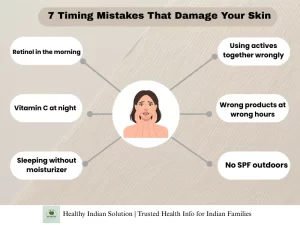
“Are you doing the right steps… but at the wrong time?”
Your skincare regimen may fail because the timing of your products conflicts with your skin’s circadian rhythm rather than because your products are flawed.
Dermatology insights from 2025 state that timing accounts for 40% of skincare effectiveness.
The most frequent timing errors that people make are listed below; they are brief, straightforward, potent, and supported by science.
1. Retinol Use in the Morning
In sunlight, retinol becomes unstable and may cause photosensitivity in your skin.
UV in the morning combined with retinol causes irritation, inflammation, and accelerated aging.
Apply only at night, when cell turnover is at its highest.
2. Applying Vitamin C at Night
Pollution and UV-induced free radicals are combated by vitamin C, but these stressors are absent at night.
Antioxidant studies from 2025 show a 30–40% decline in results.
The best time is in the morning to counteract oxidative damage during the day.
3. Ignoring SPF Indoors
According to a 2025 study, low-level HEV/blue light from indoor light sources (LED screens, tube lights, laptops) accelerates:
- Pigmentation
- Melasma
- early aging
One of the hidden causes of persistent dark spots indoors is missing SPF.
The ideal time is in the morning, plus every three to four hours if you’re close to a screen.
4. Dozing Off Without Moisturizer
Your skin loses a lot more water between 12 and 3 AM (TEWL increases naturally).
Weak repair due to dry skin results in dullness the following morning.
Night moisturizer: retains moisture and promotes collagen and healing.
5. Using the Same Routine All Year
Your surroundings change, but your circadian rhythm remains constant:
Winter air: More dryness due to low humidity
Summertime heat: More UV and sebum
Monsoon: Increased risk of fungal acne
Your merchandise needs to change with the seasons.
12 months of the same routine equals stalled progress.
6. Harsh Actives Overlapping at the Wrong Time
Example Mistakes:
- AHA and retinol on the same evening
- Exfoliants and high-strength vitamin C in the morning
Your skin barrier is compromised, which hinders the circadian repair cycle’s ability to function.
A straightforward guideline:
- Actives on Rotation
- Daily hydration
7. Ignoring the Energy Peaks of Your Skin
The majority of absorption takes place at night.
The majority of oxidative damage occurs during the day.
However, a lot of people reverse this: using antioxidants at night and drinking water in the morning equals poor outcomes.
To get the most out of it, pay attention to your body clock.
Food & Lifestyle That Support Circadian Skin Health

“Is your phone screen killing your glow more than pollution?”
Your diet, sleep patterns, stress levels, and habits all have a direct impact on how well your circadian rhythm protects and heals your skin.
According to dermatology research from 2025, up to 60% of the circadian balance of skin is influenced by lifestyle.
This is a straightforward, scientifically supported guide.
Morning Foods to Increase Protection During the Day
Oxidative stress from the sun, pollution, and screens starts your day.
Your body’s natural antioxidant defenses are strengthened by these foods.
1. Fruits High in Vitamin C
Oranges, kiwis, amla, and strawberries are a few examples.
Why: They support your skin’s daily energy cycle, increase collagen, and lessen inflammation.
2. Green Tea
Rich in EGCG, a strong antioxidant.
Benefits:
- Reduces UV-induced skin damage.
- Keeps oiliness balanced.
- Reduces puffiness.
- Perfect drink to activate your skin’s “day defense mode.”
3. Water-Rich Fruits
such as papaya, apples, and watermelon.
maintains steady levels of hydration (skin dehydrates most quickly in the morning).
Best Night Foods for Repair & Renewal
Your skin does deep cellular renewal, DNA repair, and collagen synthesis at night.
1. Superior Protein
Examples include chicken (if non-vegetarian), eggs, paneer, lentils, and tofu.
Why: Amino acids required for collagen and tissue repair are found in protein.
2. Nuts (Walnuts, Almonds)
- Abundant in magnesium and vitamin E.
- Improves sleep quality + reduces skin inflammation.
3. Omega-3 Foods
Example: such as fish, chia seeds, and flaxseeds.
Advantages:
- Reduces overnight inflammation.
- Strengthens barrier.
- Improves morning glow.
Dermatology research from 2025 has demonstrated that omega-3 promotes cell membrane repair at night.
Your skin’s natural reset button is your sleep cycle.
Your skin performs its deepest repair between 10 PM – 3 AM.
But this only happens if your sleep cycle is stable.
Poor sleep leads to:
- slower collagen production
- Dullness
- Dark circles
- Higher inflammation
- Hormonal imbalance
Goal: 7–8 hours, consistent timing.
Blue Light Exposure at Night
Indeed, your laptop, phone, and LED lights interfere with:
- Production of melatonin
- The circadian rhythm
- Overnight skin repair
According to research from 2025, for some skin types, blue light increases pigmentation even more than sunlight.
Fix:
- Cut back on screen time one hour before bed.
- Use blue-light filters or night mode.
Stress & Cortisol Imbalance
High cortisol is a result of high stress.
Elevated cortisol causes inflammation, an oil imbalance, and a delayed healing process.
Impacts on skin that is circadian:
- More acne
- Increased pigmentation
- Reduced skin barrier
Easy solutions:
- 10-minute evening walk
- Deep breathing
- Short meditation
- Staying hydrated
These naturally balance cortisol and support nighttime repair.
Conclusion: The Power of Timing in Skincare
“Try aligning your routine for 7 days your skin will show the difference.”
Your skin isn’t random it follows a 24-hour biological rhythm.
Daytime is about protection, nighttime is about repair, and the products you use only work their best when they match this natural rhythm.
2025 dermatology research makes one thing clear:
- Right product and right timing gives you faster glow, deeper repair, stronger barrier. You don’t need 10 products just the correct timing with a consistent rhythm.
- Small changes like using Vitamin C in the morning, retinol at night, sleeping on time, and eating smart can completely transform your skin’s natural cycle.
A Note from HealthyIndianSolution

At HealthyIndianSolution, our goal is simple:
To help you understand your skin deeply, naturally, and scientifically without overcomplicating it.
Remember:
Skincare works best when it works with your body, not against it.
If you follow circadian skincare for just 7 days, you’ll see:
- Better glow.
- Smoother texture.
- Reduced dullness.
- Stronger morning radiance.
Your skin will tell you the difference.