
1. Introduction: Why Hair Thinning Exploded as a Global Concern in 2025
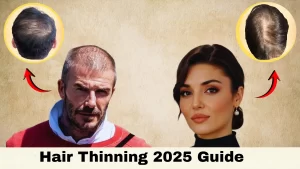
Hair thinning is not something people used to talk about openly. But in 2025, it suddenly became one of the most searched health concerns across the world. Men and women almost equally started noticing more hair on their pillow, in the shower, and on their combs. And the biggest shock?
Even people who eat well, work out, and look “healthy” started facing unexpected thinning.
So what really changed in 2025?
And the bigger question that everyone keeps asking is:
“Why are even healthy people suddenly noticing more hair fall in 2025?”
This booming rise isn’t random. It’s a mix of stress, lifestyle shifts, new-age habits, and the silent pressure of social media that has changed how we live every single day.
A. The Sudden Global Rise in Hair Thinning (Men + Women)
In the last few years, dermatologists worldwide have reported a sharp rise in hair thinning. The increase is seen in both men and women, which is unusual because earlier, pattern hair loss was mostly talked about in men.
What changed?
- More people are experiencing diffuse thinning, not just bald patches.
- Women are reporting issues as much as men because of stress, hormonal imbalance, and nutrient deficiencies.
- Screens, pollution, hair styling, and harsh products became daily habits without people realizing the damage.
4. This rise didn’t happen slowly it became noticeable almost overnight between 2023–2025.
B. Social Media, Stress & Lifestyle: The Real Triggers in 2025
Social media looks harmless, but the pressure it creates is not. Comparing yourself with perfect-looking influencers raises daily stress levels without you noticing.
Here’s what changed in daily life:
1. Constant Stress (the silent hair killer)
Work pressure, competition, and the “hustle culture” trend increased chronic stress among young adults.
Chronic stress – raises cortisol – pushes hair into shedding phase early. This is one of the biggest reasons doctors saw a spike in hair fall in 2025.
2. Lifestyle Changes Nobody Talks About
- Sleeping late every day
- Skipping micronutrients
- High-sugar snacks
- Long screen time
- No sunlight → low vitamin D
- Pollution exposure
These micro habits together lead to weaker follicles and slow regrowth.
3. Social Media Beauty Pressure
People apply every trending product serums, oils, DIY treatments without checking what their scalp actually needs. Overuse of heat styling and chemical products also doubled in 2024–2025.
C. Why Younger People (18–30) Are Facing Thinning So Early
Hair thinning was once something people expected in their 40s and 50s. But now, dermatologists are seeing 18–30-year-olds with early signs of miniaturization.
Why the early shift?
- High academic and job stress
- Less protein in diet
- Inconsistent sleep
- Heavy reliance on caffeine and energy drinks
- Aggressive hair treatments at salons
- More PCOS cases among young women
- Increasing male pattern sensitivity due to genetics + inflammation
- Even if you look fit from outside, the scalp can still suffer inside.
So again, the big question becomes: “Is this just hair fall… or the first signs of long-term thinning?”
D. What This Blog Will Help You With
Most people panic when hair starts falling, and they end up wasting money on random oils and trend-based products that don’t work.
In this guide, you’ll get:
- Science-backed explanations
- Derm-approved solutions
- Beginner-friendly tips
- Home care + lifestyle fixes
- New 2025 treatments that actually work
- No myths. No complicated explanation.
Just simple, real solutions that save time and actually help.
2. Hair Loss in Men
A. What Exactly Is Male Pattern Baldness?
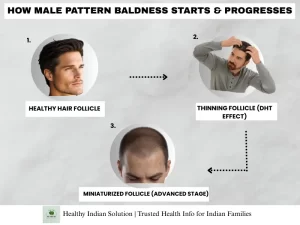
Male pattern baldness (also called androgenic alopecia) is a gradual shrinking of hair follicles on certain parts of the scalp.
Unlike regular hair fall, the hair in these areas becomes:
- Thinner
- Shorter
- Weaker
- Less likely to grow back
- The process is slow but steady… unless treated.
“Why do some men start losing hair in their early 20s while others keep a full head into their 50s?”
The answer lies in genetics, hormones, lifestyle, and scalp sensitivity.
B. How Male Hair Loss Progresses (Explained Simply)
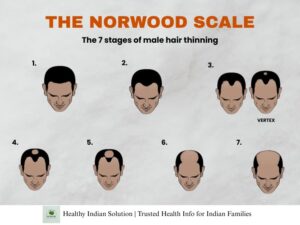
Dermatologists use the Hamilton Norwood Scale, which has seven stages.
Here’s a very simple explanation you can use:
- Stage 1
Normal hairline, almost no visible thinning.
- Stage 2
Slight recession near the temples.
- Stage 3
Clear M-shaped or U-shaped hairline.
- Stage 4
Deep recession + smaller bald spot at the crown.
- Stage 5
Hairline and crown thinning start to merge.
- Stage 6
Most hair on top becomes thin or disappears.
- Stage 7
Bald top with only a band of hair on the sides.
C. Who Gets Male Pattern Baldness?
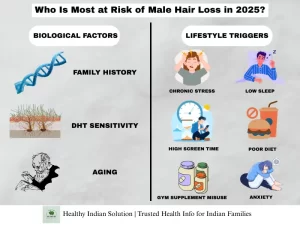
(2025 Updated Observations)
Almost all men are at risk, but certain factors increase the chances:
Family history (both mother’s and father’s side)
- Higher sensitivity to DHT
- Stress spikes (now extremely common in 18–30 age group)
- Low sleep + high screen time
- Nutritional gaps
Ethnicity Differences in 2025 Research
Newer reports show:
- White and Afro-Caribbean men – highest rates
- East Asian men (Chinese/Japanese) – lower rates
- Native American and Alaska Native populations – very rare cases
D. Does It Affect Your Health?
Physically? No.
But mentally? Yes.
Many men experience:
- Anxiety
- Low confidence
- Body image issues
- Social pressure
3. Hair Loss in Women
A. What Is Hair Loss in Women?
Women also shed 50–100 hairs daily. That’s normal.
Hair loss happens when:
- More hair is falling out
- Less hair is growing back
- Follicles become weak
- Growth cycle becomes unbalanced
The medical word for this is alopecia, but the meaning is simple: Your hair is not growing the way it should.
Why are healthy women in 2025 suddenly noticing thinning near the crown and sides?
Stress, hormones, deficiencies, and modern lifestyle play a huge role.
B. Types of Hair Loss in Women
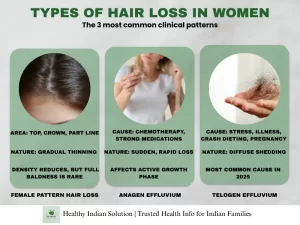
1. Female Pattern Hair Loss (Most Common)
The thinning usually happens:
- At the top
- Around the crown
- Along the parting line
- Women rarely go fully bald, but the hair becomes noticeably lighter and less dense.
2. Anagen Effluvium
This happens when hair in the growth stage is suddenly affected mostly due to medications like chemotherapy. The loss is fast and heavy.
3. Telogen Effluvium
This is when too many hairs enter the resting phase at the same time.
Triggers include:
- High stress
- Crash dieting
- Illness
- Post-pregnancy
- Sudden lifestyle changes
This is one of the biggest reasons for the rise in hair fall in 2025.
C. Why Hair Thinning in Women Is Increasing (2024–2025 Data)
- More PCOS in young adult women
- Low iron and vitamin D levels
- Sudden dieting trends
- Heat styling and hair colouring
- Sleep disturbances
- Hormonal birth control changes
- Stress from work, exams, and social media pressure
More than 50% of women will see noticeable thinning in their lifetime.
D. How the Hair Growth Cycle Works
Hair grows in three phases, like a repeating loop:
- Anagen: Growth Phase (2–8 years)
This covers about 85%-90% of scalp hair.
- Catagen: Transition Phase (2-3 weeks)
Follicle shrinks and prepares to rest.
- Telogen: Rest Phase (2-4 months)
After resting, the old hair falls out to make space for new hair. Short hairs (eyebrows, lashes, arm hair) have a much shorter growth phase.
4. Symptoms & Causes of Hair Loss in 2025 (Men & Women)
Hair loss doesn’t start suddenly your scalp gives small clues before things get serious. Most people ignore these early signs until thinning becomes visible. This guide breaks down the symptoms and causes for men and women separately so anyone can understand what’s happening and why.
1. Hair Loss in Men: Symptoms & Causes
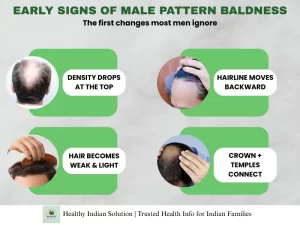
A. Early Signs of Male Pattern Baldness
Male hair loss often begins slowly, so the early symptoms are easy to miss. Here are the most common signs:
- Thinning at the Crown
A small circular area on the top of the head starts losing density.
- Receding at the Temples
The hairline begins to move back, creating an M-shaped pattern.
- Overall Reduction in Hair Thickness
Even the hair that remains feels lighter, weaker, and shorter.
- A “U-Shaped” Pattern Over Time
As the crown and temples thin at the same time, they eventually connect.
“Is your hairline actually changing, or are you just overthinking it?”
Many men don’t notice until comparing old photos this happens more in 2025 because of high stress and screen lifestyle.
B. Why Men Lose Hair: 2025 Research Explained Simply
Male pattern baldness is influenced by several factors working together. Here’s the easiest explanation:
- Age
Hair follicles naturally become weaker with age.
By 50, around half of men notice visible thinning.
- Hormones (Especially DHT)
DHT is a powerful hormone that:
- Binds to hair follicles
- Shrinks them slowly
- Makes each new hair thinner
This is why men often see progressive thinning, not sudden patches.
- Genetics (Both Parents Matter)
Your risk increases if:
- Your father has thinning
- Your maternal grandfather had pattern baldness
- Male relatives have early hairline changes
In 2025, dermatologists say genetics + lifestyle stress is the most common combo.
- Not Contagious
Male pattern baldness cannot be transmitted. It is purely internal hormones + genes + age.
2. Hair Loss in Women: Symptoms & Causes
A. What Does Hair Loss Look Like in Women?
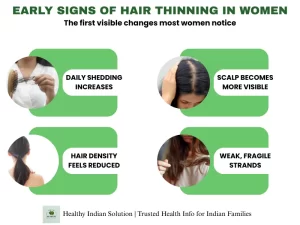
Women experience hair loss differently than men. Instead of bald patches, thinning happens more gradually and across larger areas.
Here are the most common signs:
- More Hair in Your Brush or Shower
Daily shedding increases beyond the usual amount.
- Widening Hair Part
The middle part becomes thinner and the scalp becomes more visible.
- Visible Scalp
Especially under bright light or when tying a ponytail.
- Smaller Ponytail Volume
Many women notice this before anything else.
- Hair Breaking Easily
Strands become fragile and snap off when you comb or style.
“Is your hair actually falling out, or is it breaking before it reaches full length?”
Most women confuse breakage with true hair fall.
B. What Causes Hair Loss in Women?
Female hair loss can happen due to many reasons. Here’s the beginner-friendly list:
- Weak or Damaged Hair Follicles
Over time, follicles may shrink or slow down from stress, hormones, or inflammation.
- Sudden Diet or Weight Changes
Crash dieting or rapid weight loss triggers shedding within 2–3 months.
- Emotional or Physical Stress
Stress pushes more hair into the shedding phase.
- Chemical Treatments & Excess Styling
Bleaching, straightening, heat tools → weaken the hair shaft.
- Medical Treatments
Chemotherapy/radiation cause fast and intense shedding.
- Health Conditions
Common triggers include:
- Thyroid imbalance
2. Low iron
3. Vitamin D deficienc
4. Autoimmune disorders
- Hormonal Shifts
During pregnancy, postpartum, and especially menopause.
- Medications & Supplements
Some blood pressure medicines, gout medications, and excessive vitamin A can cause shedding.
- Family History
If female relatives have thinning, the chances increase.
C. Hair Loss & Menopause: What’s the Connection?
During menopause, hormone levels fluctuate. This affects the growth cycle and leads to:
- Hair becoming thinner
- More hair shedding
- Slower regrowth
- Finer texture
- The follicles become smaller, and each new hair grows out weaker.
D. Who Is at Higher Risk?
Women are more likely to face hair thinning:
- Women are more likely to face hair thinning:
- After age 40
- After pregnancy
- During or after menopause
- After medical treatments like chemotherapy
- If hair loss runs in the family
But in 2025, stress + nutrient deficiency is now one of the biggest early triggers, even in younger women.
5. Diagnosis & Testing for Hair Loss (Men & Women)
Understanding why hair is falling requires more than just looking at the mirror. In 2025, dermatologists rely on both visual clues and scientific tests to figure out what’s really happening under the scalp. This guide explains how hair loss is diagnosed starting with men, then women in the simplest possible way.
1. How Male Hair Loss is Diagnosed
A. How Experts Identify Male Pattern Baldness
Most men can recognize the early signs of pattern baldness themselves, but a proper diagnosis helps confirm whether it’s genetics, hormones, or something else.
A healthcare professional will:
- Examine your scalp closely
- Look at the shape of your hairline
- Compare thinning areas (temples, crown, sides)
- Ask you basic questions about when you first noticed changes
“Is your hair actually thinning, or is it just the way you’re styling it?”
You’d be surprised how often men misjudge it.
B. Tests Used to Diagnose Hair Loss in Men
1. Densitometer Check
A densitometer is a small tool that magnifies the hair and measures:
- Follicle thickness
- Density of hair per area
- Shrinking patterns caused by DHT
- This test helps confirm if it’s typical androgenetic alopecia.
2. Scalp Examination
The doctor checks:
- Signs of inflammation
- Possible infections
- Scaling or redness
- Sudden-patch baldness (which is different from genetic loss)
3. Hair Sample Analysis
A few strands may be taken and sent for lab testing to check for:
- Shaft weakness
- Breakage
- Fungal infections
4. Scalp Biopsy (If Needed)
A tiny piece of skin is removed under local numbing to rule out:
- Autoimmune disorders
- Scalp diseases
- Scarring alopecia
5. Blood Tests (Only When Hair Loss Doesn’t Fit the Pattern)
These check for:
- Thyroid disorders
- Hormonal imbalances
- Vitamin deficiencies
2. How Hair Loss is Diagnosed in Women
Women’s hair loss isn’t always straightforward. It can be hormonal, nutritional, stress-related, or genetic so doctors follow a step-by-step method.
A. How Healthcare Providers Begin the Diagnosis
Your provider will:
- Examine the scalp
- Check the width of your part
- Look for breakage vs. true shedding
- Review your haircare routine
- Ask about recent lifestyle or health changes
- This first step helps determine whether it’s thinning, breakage, or shedding due to stress or hormones.
“Is your hair falling from the root, or snapping before it grows fully?”
This one difference changes the whole diagnosis.
B. Tests Used for Diagnosing Hair Loss in Women
1. Gentle Hair Pull Test
Your provider gently pulls a small group of strands to see:
- How many hairs detach
- Whether the root shows active shedding
- If breakage is happening near the end of the strand
- This identifies conditions like telogen effluvium.
2. Scalp Check Under Magnification
A small microscope helps the provider see:
- Follicle size
- Early miniaturization
- Redness or irritation
- Signs of infections
3. Blood Work (Very Common in Women)
These blood tests look for deficiencies that cause hair thinning:
- Iron & ferritin
- Vitamin D
- Zinc
- B-vitamins
- Thyroid levels
- Hormone issues (especially in women 18–45)
- This helps identify hidden causes like PCOS, thyroid imbalance, and nutrient deficiency.
4. Scalp Biopsy (Only When Needed)
A tiny scalp sample is taken to confirm:
- Pattern hair loss
- Autoimmune hair loss
- Scarring disorders
5. Trichoscopy (2025 Newer Trend)
Some clinics use trichoscopya digital imaging tool that:
- Maps hair density
- Tracks follicle shrinking
- Shows patterns that match 2025 diagnostic charts
C. Questions Your Provider May Ask (Simple & Realistic)
These questions help your doctor track the timeline and cause of hair loss:
About your hair habits:
- Do you use heat or chemical treatments often?
- Which products do you apply regularly?
- Do you wear tight hairstyles?
- Do you pull your hair out when stressed?
- About your personal history:
- Does hair loss run in your family?
- Are you under emotional or physical stress?
- Any major diet changes or weight loss recently?
- Any medications or supplements you take daily?
- About what you’ve noticed:
- When did the shedding start?
- Has it increased recently?
- Any hair loss on eyebrows or body hair?
- Does anything make it worse or better?
- Has your hair texture changed?
- Do you see more breakage than usual?
These questions help separate hormonal, nutritional, stress-related, and genetic causes.
6. Management & Treatment of Hair Thinning
1. Hair Loss Treatment in Men
2025 research shows that male pattern thinning is still the most common reason men lose hair, but the way we treat it today is more targeted and safer than before.
1. What Actually Helps Men Regrow or Maintain Hair?
A. Medications
These are the treatments most dermatologists recommend before anything else:
1. Topical Minoxidil (Foam or Liquid)
- Helps increase blood flow to the follicles.
- Works for crown and mid-scalp thinning.
- Needs consistent daily use for 3–4 months to show results.
- Stopping it makes the new hair fall out again.
- Typical side effects: mild itching, dryness, random facial hair if it drips.
2. Oral Finasteride (Prescription Tablet)
- Reduces DHT levels (the hormone linked to shrinking follicles).
- Effective for hairline, temples and crown.
- Works slowly → improvements seen from the 3rd month onward.
- Possible side effects: decreased libido, allergic reactions, minor testicular discomfort (rare).
B. Advanced or Clinic-Based Options
1. PRP (Platelet-Rich Plasma Injections)
Your blood is processed → growth factors extracted → injected into scalp. Boosts follicle recovery and thickens weak strands.
Recovery: minor soreness for 1–2 days.
2. Hair Transplant (FUE / FUT)
Healthy hair is taken from the back and moved to bald areas. Best for receding hairlines or large patches.
Recovery:
2–3 weeks of healing. Full growth visible after 9–12 months
3. Low-Level Laser Therapy (LLLT)
2025 devices (caps, helmets, brushes) have better energy delivery than old versions.
Benefits:
- Strengthens weak follicles
- Can be combined with Minoxidil or Finasteride
- C. Non-Medical Ways to Manage Thinning
- Choosing hairstyles that reduce the look of gaps
- Using fibers or thickening sprays
- Avoiding tight caps or hairstyles that pull hair
2. When Will Men See Results?
Minoxidil: 2–4 months
Finasteride: 3–6 months
Laser treatments: 10–12 weeks
PRP: Visible thickening after 2–3 sessions
Transplant: 9–12 months
2. Hair Loss Treatment in Women
Women’s hair thinning is often more complex because multiple factors hormones, stress, deficiencies, styling habits can overlap. So treatment depends heavily on the root cause.
1. First Steps Before Treatment
A dermatologist will normally fix three things first:
- Lifestyle stressors
- Nutritional deficiencies (iron, D, B12, zinc)
- Hair care routines causing damage
- Once these are stable, treatment options work faster.
2. Treatment Options for Women
A. Everyday Changes That Make a Huge Difference
- Reducing stress levels (therapy, journaling, yoga)
- Avoiding harsh chemical treatments
- Taking supplements only if deficient
- Switching to loose hairstyles
- Reducing heat styling
- These alone help many women who experience postpartum or stress-related shedding.
B. FDA-Cleared Devices for Women
Women can now use light-based therapy safely:
- HairMax LaserComb®
- Theradome LH80 PRO® helmet
- Similar LLLT caps approved after 2023
- They help follicles that are miniaturising.
C. Clinic-Based Treatments
1. Micro-needling With or Without Minoxidil
- Creates micro-channels that allow better absorption
- Encourages collagen + blood flow in the scalp
2. PRP (Protein-Rich Plasma Injections)
- Popular for female pattern thinning
- Helps with diffuse thinning at the crown and parting line
3. Hair Transplant Surgery
Works best when thinning is localized, not spread across entire scalp
D. Medications Often Used for Women
1. Minoxidil (2% or 5%)
- Safest and most commonly recommended option
- Must be used long-term
- Not safe during pregnancy or breastfeeding
- Side effects: dry scalp, irritation, hair growth on face if applied incorrectly
2. Spironolactone (Anti-Androgen)
- Helps women with hormone-related hair thinning
- Reduces androgen-driven follicle shrinkage
3. Finasteride or Other DHT Blockers
- Used carefully in women; not allowed during pregnancy
- Works well in post-menopausal women
4. Steroids / Prostaglandin Analogues
- Used only in specific medical conditions
- Strictly under dermatologist guidance
3. When Women Notice Improvement
Minoxidil: 10–12 weeks
Micro-needling: 6–8 weeks
PRP: 2–3 months
Light therapy: 3–4 months
Hair grows slowly, patience is the biggest factor.
3. Who Should Women Consult?
The best expert for female hair thinning is always a dermatologist especially one specializing in hair disorders (trichology).
7. Prevention for Hair Loss(Men & Women)
1.Preventing Hair Loss in Men: What Actually Works in 2025?
Hair thinning in men can’t always be stopped completely especially when genetics are involved. But many men can slow it down and protect their existing hair by taking consistent, science-backed steps.
“If hair loss runs in the family’, is there anything a man can do to delay it?”
The answer is yes, not completely, but definitely delay and minimize it.
A. Why Complete Prevention Isn’t Possible (2025 Reality Check)
Male pattern baldness is mostly controlled by:
- Your genes
- Your hormone sensitivity (especially DHT)
- Your age
- These three things can’t be changed that’s why scientists still don’t have a “100% prevention method”.
But the good news:
You can protect the hair you still have and reduce the speed of thinning.
B. Smart Prevention Habits for Men
1. Eat Enough Protein Daily
Most men are low on protein without realizing it. Your hair needs it for growth, thickness and repair.
Daily goal:
40–60 g protein minimum (more if you go to gym).
2. Follow a Mediterranean-Style Diet
2025 research shows this pattern reduces inflammation around hair follicles.
Include:
- Fresh fruits
- Leafy vegetables
- Nuts
- Olive oil
- Eggs & lean meats (Or paneer + lentils for vegetarians/vegans)
3. Keep Stress Under Control
Chronic stress raises androgen activity triggers faster thinning.
You can try:
- Breathwork
- 10–15 min daily walk
- Meditation
- Journaling
- Limiting caffeine
- Small lifestyle changes show big differences in hair density within months.
4. Gentle Haircare Routine
Avoid: harsh shampoos, random hair oils, and aggressive towel drying.
Use: sulfate-free shampoo + mild conditioner.
2. Preventing Hair Loss in Women: What You Can Control in 2025
Women face hair fall for many reasons hormones, stress, rapid weight loss, nutrient gaps, heat styling and more. Not all types can be prevented, but many can be reduced or delayed with small daily habits.
“Can women stop hair fall before it starts, or is it always hormonal?”
The truth:
Hormones matter, but your daily habits matter just as much.
A. Why Complete Prevention Isn’t Always Possible
Hair loss tied to:
- Pregnancy
- Menopause
- Genetics
- Medical conditions
cannot be fully avoided. But the triggers that worsen it can be controlled.
B. Smart Prevention Habits for Women
1. Avoid Chemical Damage
Straightening, bleaching, smoothening and keratin treatments stretch and weaken the hair shaft. If you must color your hair choose ammonia-free options.
2. Eat a Hair-Friendly Diet
Women commonly lack iron, Vitamin D, B12 and protein all essential for hair density.
Include:
- Dal, paneer, eggs, fish
- Spinach
- Dry fruits
- Whole grains
- Supplements only if advised by a doctor.
3. Massage Your Scalp Regularly
A simple 2–3 minute massage during shampooing boosts micro-circulation and improves nutrient delivery to follicles.
4. Hairstyles That Don’t Pull
High ponytails, tight braids and extensions create traction slow, permanent thinning.
Choose:
- Loose buns
- Low ponytails
- Soft hair ties
5. Use Lightweight, Volume-Friendly Products
Choose:
- Sulfate-free volumizing shampoo
- Mild conditioner on ends only
- Avoid heavy oils on scalp
8. A Note From Healthy Indian Solution

Hair thinning can feel overwhelming especially when it starts suddenly or before you expect it. But one thing we want every reader to remember is this:
Hair loss is not a failure of beauty, It’s a signal from your body that deserves kindness, patience and proper care.
At Healthy Indian Solution, our goal is simple, To give you clear, science-backed guidance in the simplest words so you never feel lost, confused or alone on your health journey.
If you are reading this and dealing with thinning hair breathe, You’re not late, You’re not behind, You haven’t “ruined” anything. Hair grows slowly, but recovery starts the moment you understand the root cause and take the first gentle step toward fixing it. And if this guide helped you even a little, that means you’ve already started healing.
“Hair doesn’t just grow from the scalp it grows from how gently you treat yourself every single day.”
-Healthy Indian Solution